The first time my Korean co-worker sent me a KakaoTalk message with just a single dot (`.`), I thought my phone was glitching. Then came the dreaded “ㄱㄱ” and a flurry of emoticons that looked like ancient hieroglyphs. I stared at my screen, sweating, convinced I’d already offended someone. Welcome to the true first hurdle of Korean culture—it’s not the language, it’s the unwritten rules of digital and social hierarchy.
You can learn Korean grammar from a textbook, but no app will teach you the subtle art of *nunchi* (눈치) or why you must always receive a drink with two hands. After a decade here, I’ve cracked the code. Here is your survival guide to the top cultural traits that will save you from awkward silences and accidental faux pas in Daejeon or anywhere else in Korea.
1. The Hierarchy of Age (서열) is Non-Negotiable
You will be asked your age within five minutes of meeting someone. This isn’t rude; it’s the operating system of Korean society. It dictates your language level (jondaetmal vs. banmal), who pours the soju, and who pays for dinner. The moment you arrive, you are slotted into a specific rank. As a foreigner, you get a slight pass, but don’t abuse it. Use the honorific “-ssi” (씨) until you are explicitly told to use a different form. If you are older, you are expected to act like a responsible elder (paying for meals is a good start). If you are younger, you must show respect, which means actively refilling your sunbae’s (senior’s) glass before it hits empty.
2. The Speed of “Ppali Ppali” (빨리 빨리)
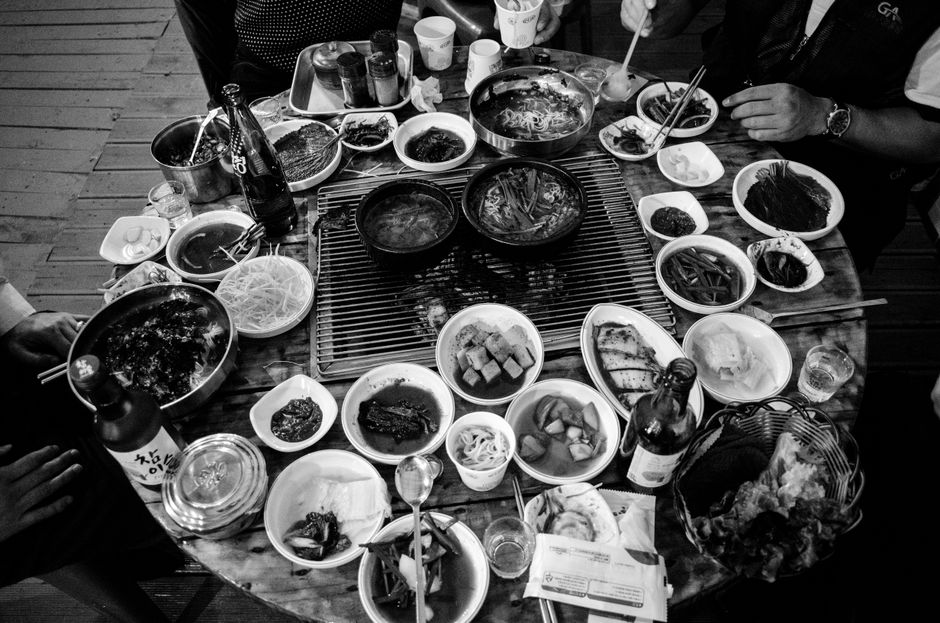
Korea runs on the “hurry, hurry” principle. This isn’t just about fast internet; it’s a cultural mindset regarding time and efficiency. Shipping is lightning fast, and responses to messages are expected almost immediately. If you are slow to reply or take too long to cross the street in Dunsan, you will feel the pressure. The practical tip here is to adapt your internal clock. Don’t be late to social gatherings (it’s a cardinal sin), but also don’t be surprised if a “quick” lunch turns into a 40-minute marathon of side dishes being slammed onto the table. Embrace the speed. When a waiter yells “주문할게요!” (I’ll order!), don’t dawdle—have your order ready.
3. The Collective “We” vs. The Individual “I”
In Western cultures, we often prioritize the individual. In Korea, the group (우리) comes first. “Our” company, “our” home, “our” team. This manifests in daily life as a strong emphasis on community harmony. You will be invited to “회식” (hoeshik—company dinner) and expected to attend, even if you’re tired. It’s not just about food; it’s about bonding and solidarity. The practical tip: when you receive a compliment, deflect it and credit the team. When you make a mistake, apologize sincerely and quickly to restore group harmony. Do not be the loud, confrontational foreigner who disrupts the flow. Be the “easy to work with” person, and you will find doors opening everywhere.
—
The Brutal Truth
The “We” culture has a dark side: extreme social conformity. You will be judged on what you wear, where you live, and how you speak. The brutal truth is that you will never fully be “Korean.” Even after 10 years, you will still be a *foreigner* (외국인). This isn’t necessarily malicious, but it means you are often observed under a microscope. Your mistakes are often excused as “because he’s a foreigner,” which is a double-edged sword—it gives you freedom, but it also prevents you from ever being fully trusted with deep responsibilities. Accept this reality early on to save yourself years of frustration.
—
The Final Word
Living here is a marathon, not a sprint. You will stumble, you will accidentally bow to the wrong person, and you will definitely eat something you can’t identify. That’s okay. The beauty of Korea is that if you show genuine effort and respect for the culture, the people will welcome you with an open heart and a full glass of Makgeolli. Keep your eyes open, your ears sharp, and your nunchi sharp.
Fighting! (화이팅!)
태그 : 한국 문화 특징, Korean workplace hierarchy tips, Daejeon expat survival guide, Korean social etiquette for foreigners, how to use nunchi, Korean group chat culture explained, living in Dunsan Korea
🛒 Korea Life Essential: Korean phone grip strap
One of the must-have items to make your life in Daejeon Dunsan, Others easier and more enjoyable!
| 🇰🇷 Coupang | Buy on Coupang |
| 🌍 AliExpress | Buy on AliExpress |
This post contains affiliate links. We may earn a small commission at no extra cost to you.
