I remember standing in the middle of Hyehwa Station exit 2, clutching a melting latte, completely paralyzed by the sheer speed of the elderly woman power-walking toward me. I tried to step left; she stepped left. I stepped right; she stepped right. I froze, expecting a polite nod or a “sorry,” but she simply clicked her tongue, brushed past my shoulder, and disappeared into the crowd. That was my first hard lesson in Korean spatial awareness: you are either moving or you are an obstacle.
Living in Hyehwa, surrounded by the buzz of Sungkyunkwan University and the constant hum of theater-goers, is a crash course in Korean social dynamics. It’s a vibrant, chaotic, and beautiful place, but the cultural rules here are written in invisible ink. If you don’t learn to read them quickly, you’re going to feel like you’re constantly swimming upstream.
Here is your survival guide to understanding the cultural traits that govern daily life in this neighborhood.
The “Pali Pali” (Hurry Hurry) Mentality is Real
In Hyehwa, everything moves at 2x speed. This isn’t just about walking fast; it’s about efficiency. The “Pali Pali” culture dictates that waiting is a waste of time. You will see this at cafes where your drink is served before you can put your wallet away, or in restaurants where side dishes appear before you sit down. To survive this, you must adapt your reaction time. Have your payment method ready before you reach the register. Don’t dawdle in doorways. If you are meeting friends, arrive five minutes early. If you are slow, you will be gently pushed aside—not out of malice, but because the collective flow of the group is more important than the individual’s pace.
The Hierarchy of Age and “Nunchi”
In Hyehwa, you will likely interact with students and locals who operate on a strict hierarchical social structure. The concept of “Nunchi”—the art of reading the room—is essential here. It’s not just about being polite; it’s about anticipating needs. If you are the youngest at the table, you pour the drinks. If you are with a professor or an older colleague, you hold the door. For foreigners, the biggest trap is treating everyone as an equal peer immediately. You must establish the age dynamic first. Ask “How old are you?” early in the conversation. It’s not rude here; it’s a necessary navigation tool. Once you know the hierarchy, you know how to speak, how to bow, and how to behave. Ignoring this won’t make you “cool”; it will make you “uncivilized.”
The “Jeong” of Sharing Spaces
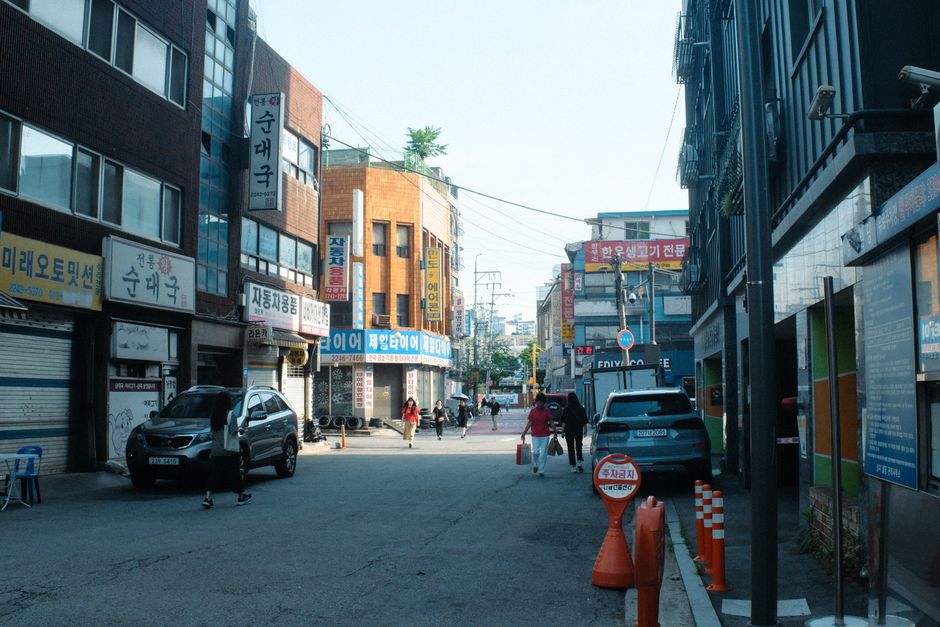
Despite the pushing and shoving, there is a deep undercurrent of “Jeong”—a bond of affection and attachment. In Hyehwa, this manifests in shared spaces. You will see groups of strangers sitting on the steps of Marronnier Park sharing food or drinks. The cultural trait here is communal harmony. If you buy a coffee at a local cafe, don’t be surprised if the owner gives you a free piece of candy or a refill. This is “service.” However, you must reciprocate the energy. Acknowledge the owner, say thank you (Kamsahamnida), and don’t treat the establishment like a library. This area thrives on reciprocal warmth. If you treat it like a cold transaction, you will be treated coldly in return.
The Brutal Truth: You Will Always Be an Outsider
Here is the harsh reality that no one wants to tell you: no matter how fluent you become in Korean, no matter how well you understand the culture, or how long you live in Hyehwa, you will often be treated as a permanent guest. The concept of “Uri” (We) is very strong. You can be welcomed into the group, but you will rarely be considered fully “one of us” in the deep, ancestral sense. This can be isolating. You will have moments where the table goes quiet because they switch to rapid-fire Korean, not to exclude you, but because they forgot you were there. You have to develop a thick skin. You cannot force your way into “Uri.” You have to accept that your role is that of a bridge—a foreigner who understands, but who is still outside looking in. It’s a lonely feeling, but accepting it is the only way to stop being angry about it.
Conclusion
Hyehwa is a magical place to live. The theaters, the diverse food, the energy of the students—it’s a bubble of youth and art in the middle of Seoul. But to enjoy it, you have to play by the rules. Move fast, respect the hierarchy, share your warmth, and accept the boundaries. It’s a tough school, but the education is worth it.
Stay sharp out there, fellow expats. We’re all just trying to find our way through the crowd.
태그 : 외국인이 보는 한국 문화, Hyehwa expat guide, Korean cultural traits, living in Seoul, Korean social hierarchy, nunchi meaning, pali pali culture
🛒 Korea Life Essential: Korean heating pad, Hangul keyboard stickers

One of the must-have items to make your life in Hyehwa, Seoul easier and more enjoyable!
| 🇰🇷 Coupang | Buy on Coupang |
| 🌍 AliExpress | Buy on AliExpress |
This post contains affiliate links. We may earn a small commission at no extra cost to you.