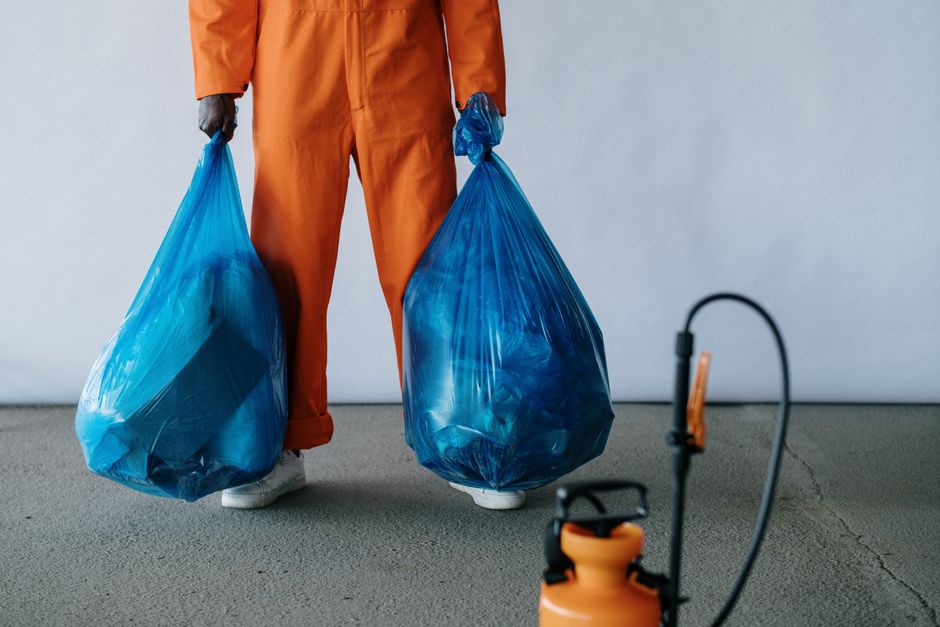
I remember my first week in Dunsan. I had a mountain of cardboard boxes from my new couch and a suspiciously large pile of broken plastic hangers. I confidently dragged it all to the curb, feeling smug about my eco-friendly intentions. The next morning, my cardboard was still there, but my hangers were gone. So was my deposit on the apartment. I learned the hard way that in Korea, trash isn’t just thrown away—it’s a bureaucratic minefield.
Here is the no-nonsense survival guide to navigating the trash system in Daejeon, especially if you’re in the Dunsan area.
1. The “Standard” Bag is Your Only Friend (For General Trash)
Forget using any old black bag. In Daejeon, you must use the official, government-issued 종량제 봉투 (jongnyangje bongtu)—the standard volume-rate trash bags. These are sold at any local convenience store (GS25, CU) or supermarket. You’ll pay for the bag itself, which covers the disposal fee. If you put your trash in a random bag, the collectors will simply leave it, and your landlord *will* find out. The bags come in various sizes (10L, 20L, 50L), and for apartment complexes, you usually toss them into a designated shared dumpster. For a single-person household, the 10L bag is your daily workhorse. Don’t be cheap and try to stuff a 50L bag to the brim; if it rips, they won’t take it.
2. Food Waste: The Wet, Smelly, Scaled Battle
Food waste is a separate beast. You cannot put it in the general trash bag. You must scrape food scraps into the specific 음식물 쓰레기 (eumsikmul sseuregi) bins. In Dunsan, most modern apartments have a centralized food waste bin that uses a specific RFID card or a special bag purchased from the management office. If you’re in a smaller villa (빌라), you might have a communal bucket with a scale. You pay by weight. The golden rule: No bones, no shells, no seeds, and no liquid. These are considered “general waste” and will contaminate the food waste batch. Also, beware of the “peel police”—some strict complexes will reject your bag if it has too much onion skin in it.
3. The “대형 폐기물 신고” (Large Waste Item Declaration) Is Not Optional
This is the one that gets most foreigners. If you’re throwing away a sofa, a mattress, a large appliance, or a broken TV, you cannot just leave it on the curb. You must perform a 대형 폐기물 신고 (daehyeong pyegimul singo)—a large waste item declaration. It’s a paid sticker system. You go to the local *gu* office (like Seo-gu or Yuseong-gu) website, register the item, pay the fee (usually between 10,000 to 50,000 KRW depending on size), and then print a sticker to attach to the item. For foreigners, the trick is to use the “대형폐기물” app or the “우리동네” app which has an English version. Alternatively, your building manager (관리소) often has the stickers in-house for a small surcharge. Just ask the ajumma at the management office. If you skip this, the collectors will not take it, and you could get fined up to 1 million KRW. I’ve seen a perfectly good IKEA desk rot in the rain for a week because the owner skipped this step.
The Brutal Truth
The system is not designed to be convenient; it is designed to be strictly enforced. There is no “grace period.” If you are a foreigner, you are a target for inspection. Neighbors *will* rat you out. The police and local wardens *will* open your trash bags to check if you’ve sorted properly. If they find a plastic bottle in your general waste bag, that’s a fine. I once got a warning letter for accidentally throwing a banana peel in the wrong bin. The only way to survive is to be more obsessive about sorting than the Koreans themselves.
Conclusion
Look, it feels insane at first. Paying for trash bags and registering your own couch feels like a tax on existing. But you’ll get used to it. You’ll start to feel a weird sense of pride when you perfectly crush a cardboard box and tie it with string. You’ll become a master of the “squeeze the air out of the bag” technique. It’s just another layer of the Korean experience—a mix of civic duty and bureaucratic chaos that makes you a more mindful resident. You’ve got this, *hwaiting*!
태그 : 대형 폐기물 신고, Daejeon trash disposal rules, Korean standard trash bags, expat recycling guide Korea, food waste Korea apartment, Dunsan moving out trash, Korean waste sticker system
🛒 Korea Life Essential: Korean standard trash bag
One of the must-have items to make your life in Daejeon Dunsan, Others easier and more enjoyable!
| 🇰🇷 Coupang | Buy on Coupang |
| 🌍 AliExpress | Buy on AliExpress |

This post contains affiliate links. We may earn a small commission at no extra cost to you.