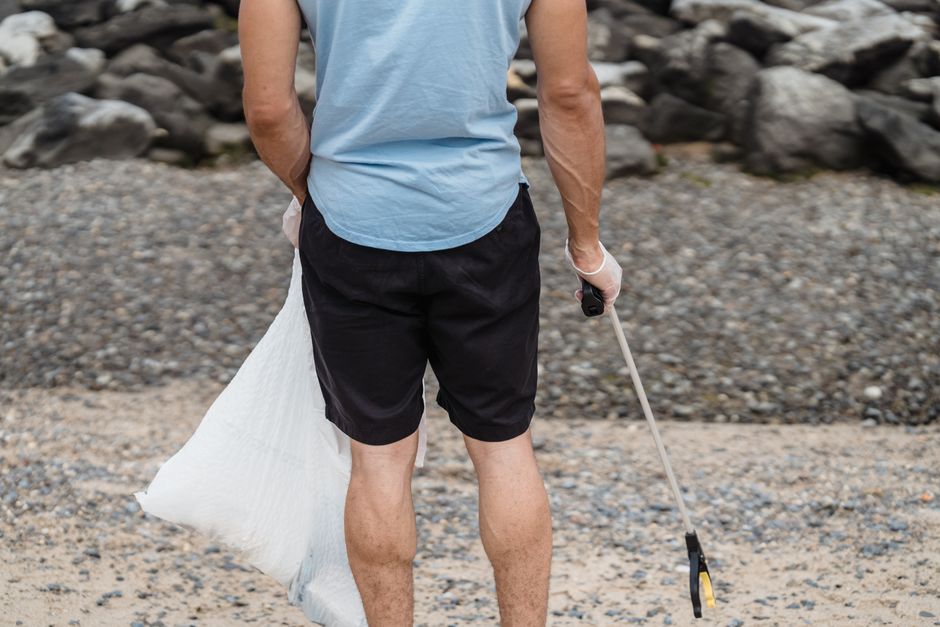
I remember my first week in Gwangalli. I had a box of chicken bones, a soju bottle, and a pile of recyclables, and I stood in front of my apartment’s trash room feeling like I was trying to solve a cryptic puzzle. The Korean signage might as well have been hieroglyphics, and the ajumma next door was staring at me with the judgment of a thousand suns. I threw the soju bottle in the regular bin. Big mistake. Two days later, my landlord left a passive-aggressive note in English that just said, “NO. SEPARATE.” This is your survival guide so you don’t have to learn the hard way.
Tip 1: Buy the Right Bags (종량제 봉투 가격) or Pay the Price
You cannot use any old plastic bag for general waste in Gwangalli. You must purchase the official government-issued bags, which are color-coded by district. In Busan, they are typically white with a blue or green stripe. The ‘종량제 봉투 가격’ (standard bag price) varies by volume, but you’re looking at roughly 500 KRW for a 10L bag and up to 1,500 KRW for a 50L bag. Do not buy the Seoul bags in Busan; they are not interchangeable. You can find these at any local convenience store (CU, GS25) or the neighborhood mart. Ask for “쓰레기 봉투” (sseuregi bongtu). If you use a random bag, the garbage collectors will simply leave it on the curb, and your landlord or the building manager will track you down. It’s not a fine from the police initially; it’s a fine from your building’s CCTV footage.
Tip 2: The Holy Trinity of Separation (Food, Recyclables, and General)
Gwangalli is strict because it’s a high-traffic tourist and residential zone. You need three distinct piles in your apartment:
1. Food Waste (음식물 쓰레기): This goes in a special yellow or green bin (often provided by your building) or a dedicated food waste bag. Key rule: Drain the water. If it’s dripping, it’s too heavy, and you will be charged extra. Remove all stickers and rubber bands. Chicken bones and eggshells are technically NOT food waste in most districts—they go in general trash. This is the most common trip-up for foreigners.
2. Recyclables (재활용): This is a separate clear bag or a designated area. You must rinse out plastic containers, crush cardboard boxes flat, and separate paper from plastic. Styrofoam is recyclable but must be clean. Do not put greasy pizza boxes in the recyclables; they contaminate the whole batch and will be rejected.
3. General Waste (일반쓰레기): Everything else that isn’t recyclable or food goes into the official paid bag.
Tip 3: The Gwangalli “D-Day” Schedule Is Real
You don’t just put trash out whenever you want. In Gwangalli, there are specific collection days for each type of waste. Usually, general waste is picked up early morning on weekdays, and food waste is picked up on a separate day. Recyclables often have a specific day too. If you miss the pickup, you are holding onto a bag of rotting food for four days. Check the notice board in your apartment elevator or the stickers on the designated trash drop-off point. It is usually written in Korean and English near the main gate. If you live in a villa (빌라), you might have to put the bags out on the street curb by 8 PM the night before. If you live in a high-rise officetel, you might have a chute on your floor. Know your building’s specific rule, or you’ll be living with the smell of fermented kimchi and banana peels.
The Brutal Truth
The system is not designed for convenience; it is designed for compliance. You will be judged by your Korean neighbors, and the “honor system” is actually a surveillance system. There are CCTV cameras at every designated trash point in Gwangalli. If you mix a banana peel in with your plastics, the collector will not sort it out for you. They will attach a bright yellow warning sticker to your bag with your building number, and the management office will fine you. It’s not a matter of *if* you’ll mess up; it’s a matter of *when*. The sooner you accept that you are a temporary guest in a highly regulated waste matrix, the easier your life will be.
Conclusion
Listen, I get it. It feels like a second job just to throw away a ramen packet. But once you get the rhythm down, it takes less than five minutes a day. You’ll start feeling a weird sense of pride when you properly crush a can and separate the label. You’ll be the foreigner who the ajummas nod at in approval. Don’t fight the system; just game it. You’ve got this, and Gwangalli is beautiful—don’t let a trash fine ruin your beach view.
태그 : 종량제 봉투 가격, Korean trash bag rules, Busan Gwangalli recycling guide, expat waste management Korea, Korean food waste separation, how to dispose trash in Busan
🛒 Korea Life Essential: Korean standard trash bag dispenser
One of the must-have items to make your life in Gwangalli, Busan easier and more enjoyable!
| 🇰🇷 Coupang | Buy on Coupang |
| 🌍 AliExpress | Buy on AliExpress |
This post contains affiliate links. We may earn a small commission at no extra cost to you.