I still remember my first week in Hyehwa. I was staring at a Korean real estate app, convinced I had accidentally opened a math exam. Jeonse? Wolse? A deposit of 50,000,000 KRW that I get back? A monthly rent that’s actually low but requires a “key money” deposit of 10 million? I felt like an idiot. I called my Korean friend, who laughed and said, “Oh, just pick one.” That was the most useless advice ever. It took me three moves and one near-heart attack to figure out the system. Let me save you the headache and the financial panic. Here is your survival guide to securing a roof over your head in Hyehwa, Seoul.
1. Decode the “전세 월세 차이” (Jeonse vs. Wolse Difference) Like a Pro
This is the biggest hurdle for expats. Jeonse is a lump-sum deposit (typically 50-80% of the property value) with no monthly rent. You get 100% back when the lease ends. It sounds like a scam, but it’s a loan to the landlord. Wolse is standard rent: a smaller deposit (usually 5-20 million KRW) plus monthly payments.
* The Expat Math: If you have the cash for Jeonse, treat it as a forced savings account. But ask yourself: can you afford to have that money locked up for 2 years? If you are on an E-2 visa, moving money out of Korea at the end can be a hassle. For most expats, Wolse is the safer bet. Look for a “half-jeonse” (반전세) if you can—you pay a bigger deposit (like 30-40 million) and a small monthly rent. This lowers your monthly burn rate without tying up your entire life savings.
* The Negotiation: In Hyehwa, with the student population, landlords know foreigners are desperate. Never accept the first price. Always counter with 5-10% lower. If they refuse to budge on Wolse, ask if they will lower the deposit instead. Landlords often prefer a higher monthly rent over a higher deposit, so use that to your advantage.
2. The “Realtor” (부동산) Is Your Frenemy—Use Them Correctly
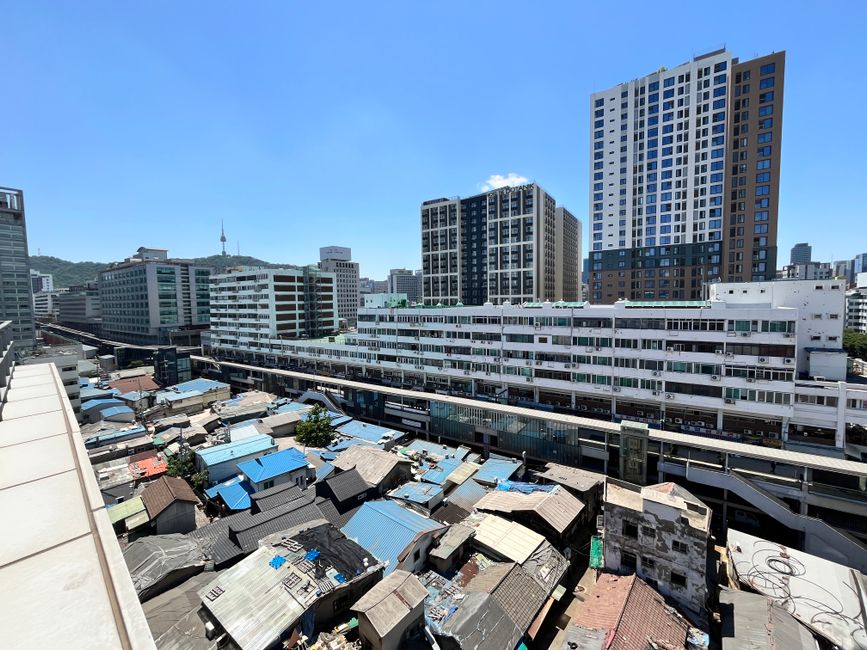
You cannot find a good place in Hyehwa on Naver or Zigbang alone. The listings are often stale or “bait.” You need to physically walk into the local 부동산 (real estate office) near the Hyehwa station exit 2. They hold the local inventory that isn’t posted online.
* The Protocol: Do not just walk in and say “I want an apartment.” You need to be specific: “I want a one-room (원룸) or two-room (투룸) near the university, within 5 minutes of the station, with a 10 million deposit and 600k monthly rent.” They will pull up a list on their ancient computer system.
* The Fee: The broker’s fee is paid by you, the tenant. It’s usually around 0.3-0.5% of the deposit, but it can be higher. Negotiate this. Ask for a discount. In Hyehwa, they are used to dealing with broke students, so they might be flexible—but only if you ask.
* The Red Flag: If the realtor refuses to give you the landlord’s contact info or says “the owner doesn’t want foreigners,” walk away. There are plenty of other offices. Also, if they push you to sign a contract immediately because “someone else is coming,” that’s a classic pressure tactic. Walk out.
3. The “Move-In” Scams and Utilities (The Hidden Costs)
You found a place. The contract is signed. You think you are done. Wrong. The day you get the keys is when the real financial traps begin.
* The Utility Check: Before you sign, ask for the last 3 months of utility bills (electricity, gas, water). In Hyehwa, many older buildings have inefficient heating systems. A winter gas bill for a small studio can be 200,000 KRW if the insulation is bad. Ask the realtor to confirm the average cost. If they hesitate, that’s a red flag.
* The “Move-In” Date: In Korea, the contract starts on the day you pay the balance. But the previous tenant usually moves out 1-2 days before. If you need to move in earlier, you have to pay a “pro-rated” daily fee. Don’t assume you can drop off boxes early. You will be locked out.
* The Deposit Return: When you move out, the landlord will inspect the apartment. They will try to deduct money for “wallpaper damage” or “floor scratches.” This is a standard scam. To protect yourself, take date-stamped photos and videos of the entire apartment *before* you move in. Send them to the realtor and the landlord via KakaoTalk. If the landlord tries to deduct for pre-existing damage, show them the evidence.
The Brutal Truth
The Korean rental system is built on trust, but as a foreigner, you have zero leverage. If a landlord decides not to return your deposit, the legal process takes months, and you’ll be paying for a lawyer. The “one-room” you saw in the photos is probably 3 square meters smaller in reality. And no one—not the realtor, not the landlord—is looking out for your financial interests. You are a walking ATM to them. The sooner you accept that, the better you’ll be at guarding your money.
The Final Word
Listen, navigating the Korean rental market is a rite of passage. It’s stressful, confusing, and sometimes feels like a game of poker where you don’t know the rules. But you *can* do this. Take a deep breath, bring a Korean-speaking friend (even a coworker will do), and don’t be afraid to walk away from a deal. The right place in Hyehwa—near the cherry blossoms, the indie theaters, and the late-night tteokbokki—is out there. You just have to be smarter than the system. Good luck, and may your deposit return in full.
태그 : 전세 월세 차이, Hyehwa apartment for foreigners, Korean real estate deposit tips, Seoul expat housing guide, Jeonse vs Wolse explained, Korean rental scam prevention
🛒 Korea Life Essential: digital door lock, korean moving boxes
One of the must-have items to make your life in Hyehwa, Seoul easier and more enjoyable!
| 🇰🇷 Coupang | Buy on Coupang |
| 🌍 AliExpress | Buy on AliExpress |
This post contains affiliate links. We may earn a small commission at no extra cost to you.