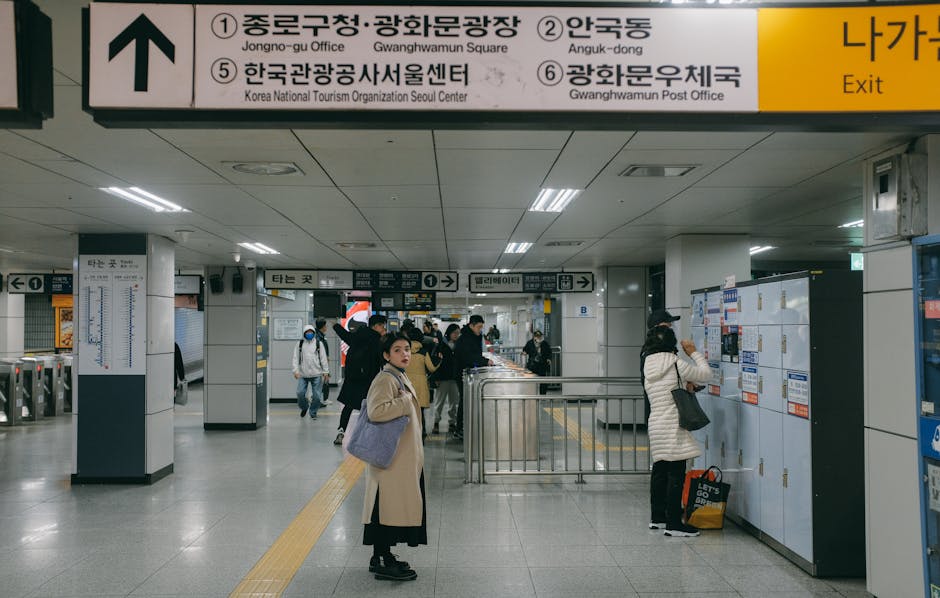
I still remember my first week in Gangnam: I was standing in front of the subway map at Gangnam Station, sweating under my winter coat (because the heating was on full blast), trying to figure out why Line 2 was a circle and why every announcement sounded like a robot having a stroke. I missed my stop twice. You won’t have to.
Master the 지하철 노선도 (Subway Map) Like a Local
The Korean subway system is a marvel of efficiency, but the 지하철 노선도 can look like a plate of colorful spaghetti at first. Download the “KakaoMetro” app immediately. It’s in English, shows real-time train arrival times, and highlights the fastest route. In Gangnam, Line 2 (the green circle) is your lifeline—it connects you to key areas like Samseong (COEX) and Seolleung. But here’s the hack: never trust the English station names alone. Learn the Korean names (e.g., Gangnam is 강남) because many signs have typos or inconsistent Romanization. Also, memorize the exit numbers. Gangnam Station has 12 exits. If you’re meeting a friend at Exit 4 (CGV cinema) but you pop out at Exit 7 (a random bus stop), you’ll be walking 10 minutes underground.
Navigate the Bus System (Yes, You Need It)
Subways are great, but buses in Gangnam are the hidden shortcut, especially for areas like Apgujeong or Nonhyeon that aren’t directly on a subway line. Get a T-money card (buy it at any convenience store) and load it with cash. Buses are cheap (about 1,200 won per ride) and connect seamlessly with subways—free transfers within 30 minutes. Use the “Naver Map” app (not Google Maps, which is useless for walking directions here). Key tip: Blue buses run express between districts, green buses cover local areas, and yellow ones are for short hops. When boarding, tap your card on the reader near the driver; when getting off, tap again at the rear door to get the transfer credit. The brutal part? Bus stops often have no English signs, so memorize your stop’s number (e.g., “Gangnam Station Exit 4” is stop 00-000).
Master the Etiquette and Avoid Fines
Korea’s public transport has a strict code. First, no eating or drinking on subways or buses—you can get fined up to 100,000 won for spilling something. Second, give up your seat for the elderly, pregnant women, or anyone with a “silver” or “pink” seat symbol on the car. Third, on escalators, stand on the right side; walk on the left—this is not a suggestion, it’s a social rule that locals enforce with sighs. In Gangnam, where commuters are speed-walking to work, you’ll get dirty looks or a gentle push if you block the left lane. Also, download the “Seoul Subway” app for offline maps—cell signal can drop in tunnels. And never use your phone in the “priority seats” area; you’ll be glared at.
The Brutal Truth: The subway system is amazing, but it’s not designed for tourists with luggage. Gangnam Station has no elevator from the platform to the street in some exits. If you’re hauling a suitcase during rush hour (7:30-9 AM or 6-8 PM), you will be a hated obstacle. Plan your travel outside peak times or use KakaoTaxi.
Look, public transport in Korea isn’t just about getting from A to B—it’s about surviving the chaos with grace. You’ll learn to love the efficiency, the free Wi-Fi, and the fact that you can get from Gangnam to Hongdae in 30 minutes. But you’ll also learn to avoid the 8 AM crush at Gangnam Station like the plague. Keep your T-money card loaded, your map app open, and your patience high. You’ve got this.
태그 : 지하철 노선도, Gangnam subway survival tips, Seoul public transport for foreigners, using T-money card in Korea, Korean bus etiquette expats, navigating Seoul subway map
🛒 Korea Life Essential: T-money card
One of the must-have items to make your life in Gangnam, Seoul easier and more enjoyable!

| 🇰🇷 Coupang | Buy on Coupang |
| 🌍 AliExpress | Buy on AliExpress |
This post contains affiliate links. We may earn a small commission at no extra cost to you.